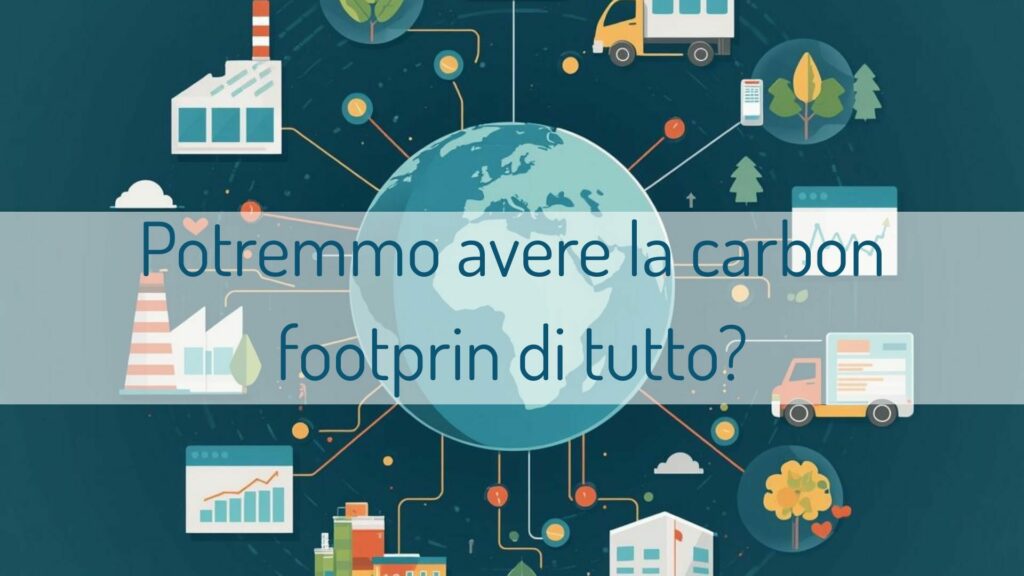
Could we have the carbon footprint of everything? And what that would really mean.
Condividi questo post
A simple question, a complex revolution
The idea is fascinating: having the carbon footprint of everything.
Knowing, for every product, service, investment or process, how much CO₂ (and other greenhouse gases) has been emitted across its entire life cycle.
This is not just a technical exercise. It’s a question that touches how we consume, how we produce, how we regulate the economy and how we imagine the transition toward decarbonisation.
But what would it actually mean to have this data available in a reliable, widespread and comparable way?
What would change if we had the carbon footprint of everything?
Imagining full climate transparency means changing the behaviour of consumers, companies and governments at the same time.
For consumers, it would mean choosing between alternatives with climate labels that are clear, verifiable and not merely decorative. A bottle, a pair of shoes, a household appliance or a ready meal would become comparable not only by price and quality, but also by emissions impact. Demand for low-emissions products would no longer be a niche gesture, but an informed everyday choice.
For companies, it would mean having a powerful lens on their value chains. The carbon footprint of each stage – raw materials, logistics, transformation, use, end-of-life – would make it possible to:
identify the critical hotspots in the supply chain,
select more climate-efficient suppliers,
reduce the risk of greenwashing, because every claim would be anchored to numbers, methods and third-party checks.
For governments, a robust and granular data base on product- and sector-level emissions would enable them to:
design more targeted taxes and incentives,
shape public procurement around concrete climate criteria,
better manage phenomena such as carbon leakage, i.e. the relocation of production to countries with weaker environmental rules.
In short, investing in better data could make every euro spent on decarbonisation policies more effective.
The four pillars of a universal carbon footprint
To move towards a scenario in which carbon footprint becomes a common language, we need solid foundations. These can be summarised in four pillars.
1. Clear reporting standards
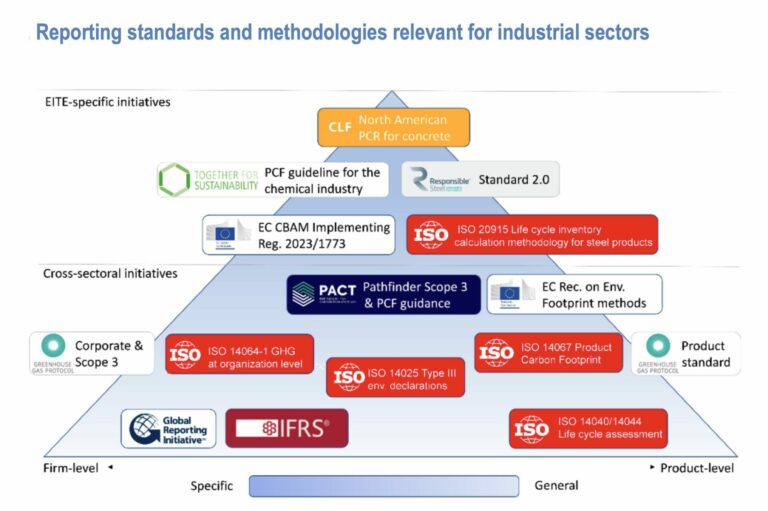
We are not starting from zero: there are already standards and guidelines such as ISO norms and the GHG Protocol, which define what to measure, how to do it and how to report it.
But to get anywhere near a “carbon footprint of everything”, these references must:
be adopted more widely,
be made consistent with one another,
be updated without fragmenting the overall framework.
2. Robust scientific methods
Emission quantification relies on methods developed and refined by the IPCC, with different levels of detail (Tier 1, 2, 3).
The higher you go, the more specific and accurate the data becomes – but also the more complex it is to obtain and maintain. The challenge is to find the right balance between scientific rigour and practicality for companies of all sizes, not just large multinationals.
3. Primary and secondary data
Primary data – collected directly from the company, process or supplier – is theoretically the best, but it comes at a cost: it requires measurement systems, trained people, time.
Secondary data, coming from databases, LCA studies and sector averages, is cheaper and faster to use, but less representative of the specific case.
Today, a realistic approach is hybrid: use good-quality secondary data as a baseline, and gradually replace it with primary data in the highest-impact areas.
4. Supply chain communication and continuous improvement
No company is an island: the real carbon footprint depends on the entire value chain.
This means we need:
reliable digital tools to exchange data between customers and suppliers,
independent verification (third parties) to give methodological and numerical credibility,
specific support for SMEs, which would otherwise risk being left out,
update processes that are regular but not chaotic.
Where we stand today: on the way, but still far
Looking at the current ecosystem, many pieces of the puzzle are already on the table:
international standards, calculation protocols, digital initiatives, growing interest from companies, investors and regulators.
Yet, full, consistent and reliable coverage is still far off. The obstacles are far from marginal:
collecting primary data remains costly and complex,
the landscape of methods and standards is fragmented,
data governance issues (ownership, competition, privacy, regulation) are not yet resolved,
verification and assurance activities are often expensive, particularly for SMEs,
the frequency of updates creates constant tension: updating frequently improves accuracy but risks generating uncertainty; updating rarely makes data quickly obsolete.
Despite this, we do not need to wait for perfection to make significant progress. Even modest improvements in data accuracy and availability can yield huge benefits, simply because the scale of the global economy – and of the decarbonisation challenge – is immense.
From data to strategy: technology as an enabler
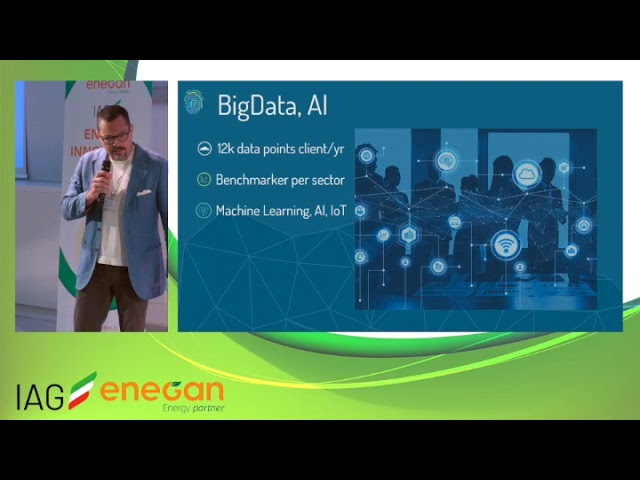
In this context, digital platforms become the first concrete ally.
They make it possible to:
collect data from different sources,
structure it in a coherent way,
calculate key indicators (carbon footprint, intensity, trends),
connect these numbers to operational and strategic decisions.
This is where the work of ecosostenibile.eu comes in.
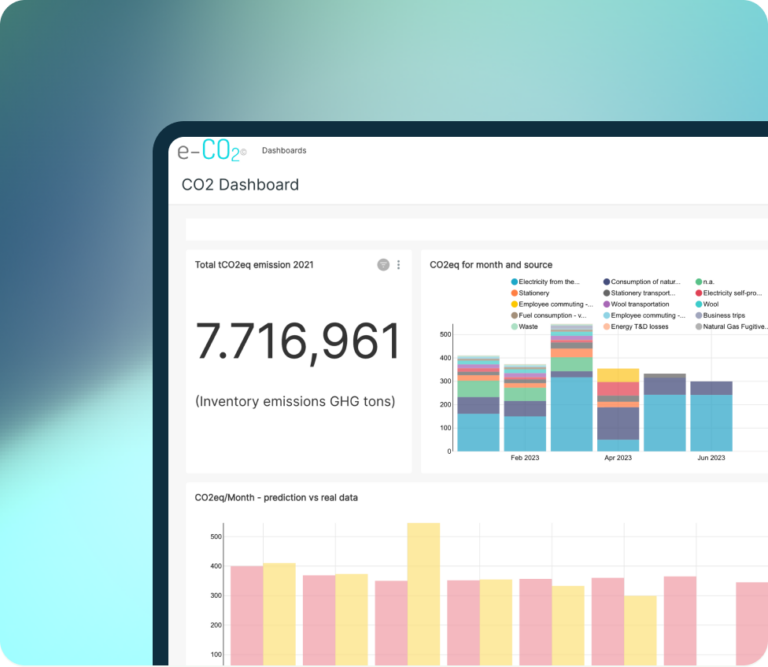
With eCO₂, the intelligent platform developed by ecosostenibile.eu® benefit company, businesses can:
immediately start measuring their emissions in a structured way,
combine primary and secondary data transparently,
build a reliable climate baseline on which to define targets and decarbonisation plans,
progressively improve the quality and granularity of their data, without freezing the business while waiting for a “perfect” system.
When well designed, technology is not an end in itself but a support to sustainability: it makes visible what was previously hidden, and helps turn carbon footprint into an everyday metric, embedded in strategy and operations.
We don’t need everything to start
We may never have the carbon footprint of everything in an absolute sense.
But we can move towards a level of coverage and reliability that is sufficient to deeply change the choices of consumers, companies and institutions.
The goal is not total control, but building a data system that is:
accurate enough to guide better decisions,
transparent enough to reduce greenwashing,
flexible enough to include even the smallest organisations.
The road to decarbonisation runs through data quality, and data quality depends on the right tools, standards and governance.
The good news is that we can start right now.
Christian Sansoni